Customer expectations are rising faster than most teams can keep up with. People now expect instant answers, hyper-relevant offers, and seamless service on every channel, every time. Generative AI customer experience is emerging as one of the most powerful ways to deliver that level of service at scale.
Instead of simply automating repetitive tasks, LivePositively AI in call centers can understand intent, generate natural language, and personalize interactions across the entire customer journey. When implemented thoughtfully, AI Call Center Solutions for Agent Productivity become a growth engine that delights customers while boosting productivity and reducing costs.
This guide explores what generative AI for customer experience really means, where it creates the most value, and how to build a practical roadmap that turns AI from a buzzword into measurable impact.
Modern businesses are increasingly turning to FlashMob Computing for distributed AI to handle complex workloads. By leveraging scalable processing power, companies can deploy AI solutions that respond to customer needs faster.
For teams seeking speed and reliability, supercomputing solutions for AI tasks provide the necessary power to process large datasets and generate insights efficiently. This enables teams to predict customer behavior and improve service outcomes.
Marketers can enhance engagement using customer-focused marketing strategies powered by AI insights. Understanding customer behavior helps deliver more personalized offers and communications that feel genuinely relevant.
Even smaller teams can benefit from practical marketing resources for businesses to implement AI-driven campaigns without getting overwhelmed. Structured guidance ensures that AI contributes to better customer experiences and measurable results.
For financial services and loyalty programs, AI tools for managing customer finances help forecast demand, personalize offers, and optimize operations while keeping clients satisfied.
Ultimately, generative AI in customer experience isn’t just about technology—it’s about transforming how businesses connect with their customers. By combining the right platforms, marketing insights, and operational guidance, teams can deliver experiences that feel personal, timely, and truly responsive, creating long-term loyalty and measurable growth.
Top 10 Contact Center Solutions for AI-Driven Customer Experience
Generative AI is transforming how businesses engage with customers, providing faster responses, personalized interactions, and actionable insights across every channel. Choosing the right contact center solution is essential to deliver exceptional service and drive operational efficiency. Here’s a list of the top 10 platforms shaping the future of AI-powered customer engagement.
1. Bright Pattern – AI Contact Center Solutions
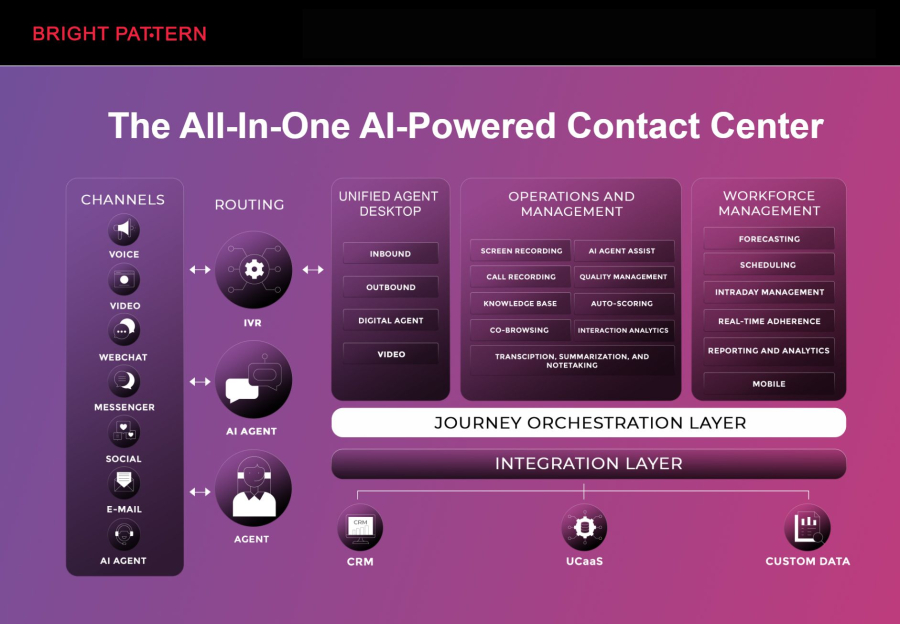
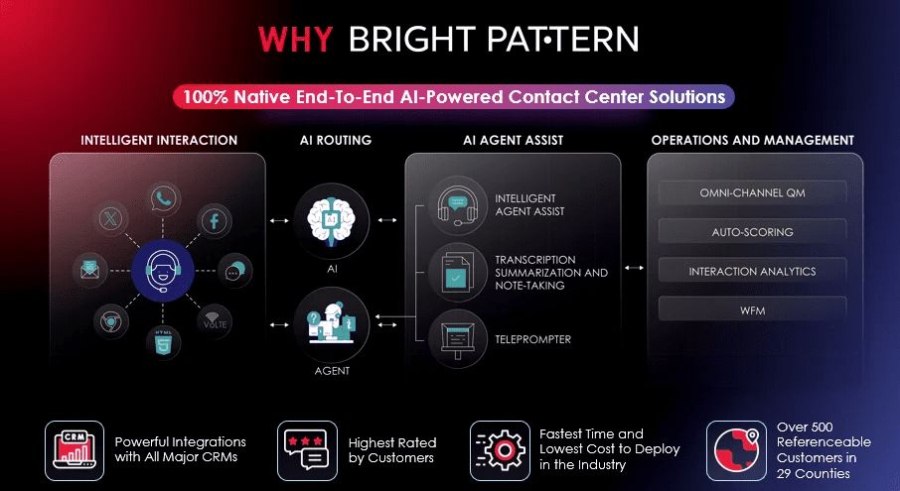
Bright Pattern stands out as a leader in AI-powered contact center solutions, offering a robust platform that combines automation, predictive analytics, and real-time insights to enhance customer interactions. Its platform is designed for businesses that want to improve agent efficiency while delivering personalized experiences across multiple channels.
Key features:
- Omnichannel support for voice, chat, email, SMS, and social media
- AI-driven routing and agent assistance to handle complex inquiries
- Advanced analytics to track performance and customer satisfaction
- Seamless integration with CRM and business applications
- Real-time dashboards for monitoring agent productivity and workflow optimization
Bright Pattern enables businesses to implement generative AI in customer experience effectively, ensuring faster response times, consistent service, and smarter agent workflows.
2. Five9 – Cloud Contact Center Software
Five9 offers cloud-based solutions with AI-powered automation, predictive dialing, and virtual assistants to streamline customer interactions. Its tools help reduce wait times and improve agent productivity while maintaining high service quality.
3. Genesys – AI-Powered Customer Experience Platform
Genesys provides a unified platform for AI-driven customer engagement. With predictive routing, chatbots, and analytics, Genesys empowers businesses to deliver more personalized and efficient service.
4. NICE inContact – Intelligent Contact Center
NICE inContact focuses on delivering intelligent contact center software with omnichannel communication, AI insights, and workflow automation to improve customer satisfaction and reduce operational costs.
5. Talkdesk – Cloud-Based AI Contact Center
Talkdesk leverages AI to automate routine tasks, analyze customer sentiment, and provide actionable recommendations for agents, enhancing overall service quality and efficiency.
6. RingCentral Contact Center – AI and Automation
RingCentral combines cloud-based communication with AI-driven tools to deliver multichannel customer support, intelligent routing, and real-time performance monitoring.
7. 8x8 Contact Center – AI Solutions for Customer Engagement
8x8 integrates AI into its cloud contact center software, offering chatbots, voice analytics, and automated workflows that improve response times and reduce agent workload.
8. Zendesk – Customer Service and AI Assistance
Zendesk provides AI-powered tools for ticketing, live chat, and knowledge management. Its AI features help streamline support processes and enhance self-service options for customers.
9. Freshdesk – AI-Enhanced Customer Support
Freshdesk uses AI to automate ticket routing, provide agent suggestions, and analyze customer interactions, enabling teams to deliver faster and more personalized service.
10. Amazon Connect – Cloud Contact Center Service
Amazon Connect offers a cloud contact center platform with AI-powered voice and chat capabilities. Its tools allow for real-time analytics, automated workflows, and dynamic customer routing to optimize experiences.
What Is Generative AI in Customer Experience?
Generative AI refers to models that can create new content based on patterns in the data they were trained on. In the context of customer experience, that content is usually language: responses in chat, summaries of conversations, personalized recommendations, or tailored email copy.
Unlike traditional rule based chatbots or scripted workflows, generative AI can:
- Interpret natural languagefrom customers, even when questions are vague or complex.
- Generate human like responsesin real time, tuned to your brand voice and policies.
- Draw on multiple sources of knowledgesuch as FAQs, product documentation, and order data.
- Continuously improvethrough feedback, new training data, and fine tuning.
In other words, generative AI is not just a smarter search box. It is a conversational layer that sits on top of your data, tools, and customer history to deliver highly relevant, contextual experiences at scale.
Why Generative AI Matters for CX Right Now
Customer experience leaders are turning to generative AI because it solves several long standing challenges at once.
- Rising expectationsCustomers compare every interaction to the best experience they have had anywhere. Response times, personalization, and empathy all matter.
- Channel explosionSupport is now expected on web, mobile, social, messaging apps, in product, and in store. Scaling teams to cover every touchpoint is costly.
- Data overloadCompanies have more data than ever, but most of it is unstructured: call transcripts, emails, chats, survey comments, and social posts.
- Talent constraintsHiring and retaining skilled support, success, and sales teams is harder and more expensive. Burnout from repetitive work is real.
Generative AI directly addresses these pressures by automating routine interactions, amplifying human agents with better tools, and turning unstructured data into actionable insights. The result is a CX operation that can do more, with better quality, without endlessly adding headcount.
Key Benefits of Generative AI for Customer Experience
When thoughtfully deployed, generative AI can transform both the customer journey and internal operations. Below are the core benefits organizations typically see.
1. Always on, high quality support
Generative AI makes it possible to offer fast, consistent support 24 / 7 without dramatically increasing staffing.
- Instant responsesAI assistants can handle large volumes of chats or messages at the same time, reducing wait times during peak hours.
- Consistent answersAI draws from a single, up to date knowledge base, so customers receive reliable information regardless of channel or time of day.
- Intelligent escalationWhen issues are complex or emotional, AI can recognize the need for a human and route the conversation with full context.
2. Hyper personalized interactions
Generative AI excels at using context to tailor experiences on the fly. It can factor in products viewed, past purchases, support history, and stated preferences to shape each interaction.
- Relevant product or content recommendationsthat feel like helpful suggestions rather than generic promotions.
- Dynamic messagingthat adjusts tone, detail, and format based on each customer’s behavior and needs.
- Next best actionsthat guide customers toward outcomes they care about, such as faster resolution or better use of a product.
3. Supercharged agents and frontline teams
One of the highest impact uses of generative AI is behind the scenes, empowering human agents to perform at their best.
- AI assisted repliesDraft responses for email, chat, or social that agents can review and personalize, cutting handle time while preserving the human touch.
- Real time knowledge retrievalAutomatically surface the most relevant articles, policies, or troubleshooting steps as agents type.
- SummarizationTurn long conversations, tickets, or case notes into concise summaries for faster handovers and reporting.
The result is less time spent searching for answers or re typing standard responses, and more time focused on empathy, problem solving, and building relationships.
4. Intelligent self service experiences
Modern customers often prefer to solve problems themselves, as long as it is quick and easy. Generative AI enables self service that feels natural and capable, not rigid or frustrating.
- Conversational FAQswhere customers can ask questions in their own words and receive clear, contextual answers.
- In product helpthat explains features, offers tips, and guides users step by step, all within the interface they are already using.
- Automated form filling and guidancethat helps customers complete complex tasks without confusion.
5. Deeper voice of customer insights
Generative AI is also a powerful analytics engine for CX leaders. It can synthesize millions of words of customer feedback into themes, pain points, and opportunities.
- Automatic taggingof support tickets, calls, and surveys by topic, sentiment, and urgency.
- Insight summariesthat highlight what customers are saying about specific products, policies, or journeys.
- Closed loop actionsby connecting insights to workflows, such as flagging systemic issues for product or operations teams.
Top Generative AI Use Cases Across the Customer Journey
Generative AI can support every stage of the customer lifecycle, from first touch to renewal and advocacy. The table below summarizes common use cases and the benefits they deliver.
|
Journey stage |
Generative AI use case |
Primary benefits |
|
Awareness & discovery |
Conversational product finders, personalized content suggestions, AI written but human reviewed landing copy. |
Higher engagement, better lead quality, more relevant first impressions. |
|
Consideration |
Interactive Q&A about features, side by side explanations, tailored demos or scenario walkthroughs. |
Reduced friction, faster decision making, more confident buyers. |
|
Purchase |
Guided checkout, plan recommendation assistants, instant clarification of terms, policies, and pricing. |
Higher conversion, fewer abandoned carts, fewer pre sales tickets. |
|
Onboarding |
Personalized onboarding flows, interactive tutorials, AI generated tips based on early usage patterns. |
Faster time to value, lower early churn, stronger initial satisfaction. |
|
Support |
AI chat and messaging support, agent assist, knowledge search, proactive alerts and guidance. |
Shorter resolution times, improved CSAT, lower cost per contact. |
|
Retention & expansion |
Health score analysis, AI drafted success plans, tailored upsell and cross sell suggestions. |
Higher renewal rates, increased revenue per customer, more relevant offers. |
|
Advocacy |
Automated NPS follow up, review request copy, summaries of positive feedback for marketing. |
More reviews, stronger social proof, clear proof points for future buyers. |
Practical Examples of Generative AI in CX
To make this more concrete, here are some typical real world patterns of how organizations use generative AI to elevate customer experience. These examples are generalized to focus on approaches rather than specific brands.
Example 1: AI first support with seamless human handoff
A digital first subscription service introduces an AI assistant on its website and in its mobile app. The assistant can:
- Handle common questions around billing, account changes, and simple troubleshooting.
- Recognize frustration, sensitive topics, or legal issues and instantly route the customer to a human agent.
- Pass the full conversation history, customer profile, and an AI summary to the agent to avoid repetition.
Customers experience faster answers for routine issues, while complex situations get more thoughtful attention from human experts. Support teams spend less time on repetitive questions and more on problems that genuinely require their skills.
Example 2: In product AI coach that improves adoption
A software company embeds a generative AI coach directly into its product. The coach observes what users are trying to do (without accessing any sensitive content) and offers guidance such as:
- “It looks like you are building a report. Would you like a quick walkthrough of the best practice template?”
- “You have not used feature X yet, but teams like yours often see strong results with it. Want to learn how it works?”
- “Here is a summary of what you achieved this week and a suggestion for your next step.”
This kind of contextual, conversational assistance helps users discover value faster while reducing the volume of basic “how do I” questions sent to support.
Example 3: AI driven voice of customer analytics
A multi channel retailer uses generative AI to analyze unstructured feedback from emails, chats, surveys, and call transcripts. The AI automatically:
- Groups similar issues into themes, such as “shipping delays” or “size guide confusion.”
- Highlights patterns by region, product line, or customer segment.
- Generates concise weekly summaries for leadership with concrete examples and suggested next steps.
This provides a near real time view of what customers are experiencing, allowing operations, product, and marketing teams to prioritize improvements that have the most direct impact on satisfaction and loyalty.
How to Build a Generative AI CX Strategy
To unlock these benefits, it is important to treat generative AI as a strategic capability rather than a one off experiment. Below is a step by step approach for building a practical roadmap.
Step 1: Define clear CX goals
Start with the customer and the business, not the technology. Clarify what you want to improve and how you will know if it is working. For example:
- Reduce average response time in digital channels.
- Increase first contact resolution rates.
- Improve onboarding satisfaction scores.
- Boost self service containment while maintaining high satisfaction.
These goals will guide which use cases you prioritize, which metrics you track, and how you design the AI experience.
Step 2: Map customer journeys and pain points
Identify specific moments in the customer journey where friction is highest or where customers need more guidance. Examples include:
- Customers abandoning checkout due to confusion about pricing or policies.
- New users struggling to complete onboarding tasks.
- Support teams overloaded with repetitive “status check” questions.
These high impact moments are usually the best candidates for generative AI, because improvements are immediately meaningful to customers and measurable for the business.
Step 3: Choose focused, high value use cases
Rather than trying to automate everything at once, select a small number of focused use cases that align with your goals. For example:
- AI chat assistantfor order status, shipping, and basic account inquiries.
- Agent assistto suggest replies and summarize interactions in your helpdesk.
- AI powered knowledge searchfor both customers and agents.
- Feedback analysisfor support tickets and survey comments.
Starting with a targeted scope helps you deliver value quickly, gather real world data, and build internal confidence.
Step 4: Prepare and connect your data
Generative AI experiences are only as good as the data and knowledge they can access. To set up for success:
- Consolidate and clean key knowledge sourcessuch as FAQs, product documentation, service policies, and internal playbooks.
- Structure access to transactional dataso AI can reference orders, subscriptions, or cases where appropriate.
- Define data governance rulesspecifying what the AI can and cannot access, with appropriate safeguards for privacy and security.
Clear, well maintained knowledge and data connections dramatically improve the quality, consistency, and safety of AI generated responses.
Step 5: Design the human in the loop experience
The most effective CX strategies combine AI and humans thoughtfully. Rather than aiming for full automation everywhere, design how AI and people will collaborate. Consider:
- Escalation rulesWhen should a conversation move from AI to a human? What cues (keywords, sentiment, time) trigger that transition?
- Agent controlHow can agents edit AI drafted replies, provide feedback, and override suggestions?
- Customer choiceHow can customers opt to talk to a human when they prefer, without friction?
A thoughtful human in the loop design keeps experiences empathetic and trustworthy, while still unlocking the efficiency and speed of AI.
Step 6: Pilot, measure, and iterate
Launch your initial use cases as pilots with clear success criteria, such as:
- Average response or resolution time.
- Self service containment or deflection rate.
- CSAT or post interaction feedback scores.
- Agent handle time and satisfaction.
Collect both quantitative metrics and qualitative feedback from customers and frontline teams. Use this input to refine prompts, update knowledge, adjust routing logic, and improve the user interface. Over time, expand to additional use cases once the first waves are stable and successful.
Data, Trust, and Governance in Generative AI CX
Because generative AI interacts directly with customers and often uses sensitive data, trust and governance are essential. A strong approach typically includes:
Clear data boundaries
- Define which systems and data fields AI can access, and for what purposes.
- Separate training data from live customer data where required by policy or regulation.
- Ensure that any personal or sensitive information is handled in line with your privacy commitments.
Controls to reduce inaccurate or inappropriate responses
- Constrain AI responses to your verified knowledge sources wherever possible.
- Use guardrails to block disallowed topics or phrases.
- Monitor a sample of interactions regularly and refine prompts or rules based on what you observe.
Transparent experiences for customers
- Make it clear when customers are interacting with an AI assistant versus a human.
- Offer easy ways to reach a person when customers want more reassurance or nuance.
- Explain how customer data is used to personalize experiences, in simple language.
These practices build confidence, reduce risk, and help you maintain a sustainable generative AI program that customers feel comfortable using.
Measuring the Impact of Generative AI on CX
To demonstrate value and guide continued investment, link generative AI initiatives to clear metrics across three dimensions: experience, efficiency, and growth.
Experience metrics
- Customer satisfaction (CSAT) after AI assisted interactions.
- Net promoter score (NPS) trends, especially for segments heavily using AI channels.
- Resolution quality as rated by customers and internal quality reviewers.
Efficiency metrics
- Average handling time (AHT) for agents using AI assist versus not using it.
- Volume of inquiries resolved through self service or AI only flows.
- Cost per contact and overall staffing requirements over time.
Growth metrics
- Conversion rates for AI supported sales or upgrade journeys.
- Retention or renewal outcomes for customers who receive AI powered onboarding or success outreach.
- Cross sell and upsell results from personalized recommendations.
Tracking these indicators helps you refine your strategy, prioritize new use cases, and tell a compelling story about the business impact of generative AI in customer experience.
Organizational Capabilities for Success
Technology alone is not enough. The most successful generative AI CX programs build a blend of people, process, and culture capabilities.
Cross functional collaboration
- CX and support teamsbring deep understanding of customer needs and frontline realities.
- Product and engineeringensure AI solutions are well integrated into existing systems.
- Data, security, and legalprovide guidance on responsible use.
- Change managementteams help train, communicate, and support adoption.
Skills and training for frontline teams
Agents, success managers, and sales reps need to understand how to work effectively with AI. Training often includes:
- How to review and refine AI drafted responses while preserving authenticity.
- When to rely on AI suggestions and when to override them.
- How to provide feedback that helps improve AI quality over time.
Continuous improvement mindset
Generative AI systems improve with iteration. Organizations that see the strongest results:
- Run regular reviews of AI interactions and metrics.
- Update knowledge sources and prompts frequently.
- Gather ideas from frontline teams on new use cases and enhancements.
A Simple Checklist to Get Started
If you are planning or accelerating your generative AI customer experience journey, use this checklist as a quick reference.
- Clarify your top one to three CX goals for the next 12 months.
- Map the customer journeys where friction is highest today.
- Select a small number of high value generative AI use cases that support those goals.
- Prepare and centralize your customer facing knowledge materials.
- Define data access rules, privacy safeguards, and escalation paths.
- Launch pilot projects with clear success metrics and limited scope.
- Train frontline teams to collaborate with AI and share feedback.
- Review performance regularly and expand to new use cases once early wins are stable.
The Future of Customer Experience Is Generative
Generative AI is quickly moving from experimentation to everyday reality in customer experience. Organizations that embrace it thoughtfully are already delivering support that is faster, more personal, and more proactive than what was possible just a few years ago.
By starting with clear goals, focusing on high impact use cases, and designing AI and humans to complement each other, you can build experiences that delight customers while making life easier for your teams. As models improve and your own data foundations mature, generative AI can become a core capability that continuously elevates the way you serve, support, and grow your customer base.
The opportunity is not just to do the same things more efficiently, but to reimagine what great customer experience looks like in an AI powered world and to lead your market by delivering it
